Naya Traveler
Redesigning the digital experience for ultra-luxury travel.
I redesigned the digital front door for a bespoke luxury travel agency whose template-built site made a curated cultural journey look like a package holiday. Editorial pacing replaced feature density, and qualified inquiries rose 38% while destination bounce fell from 48% to 29%.
View Site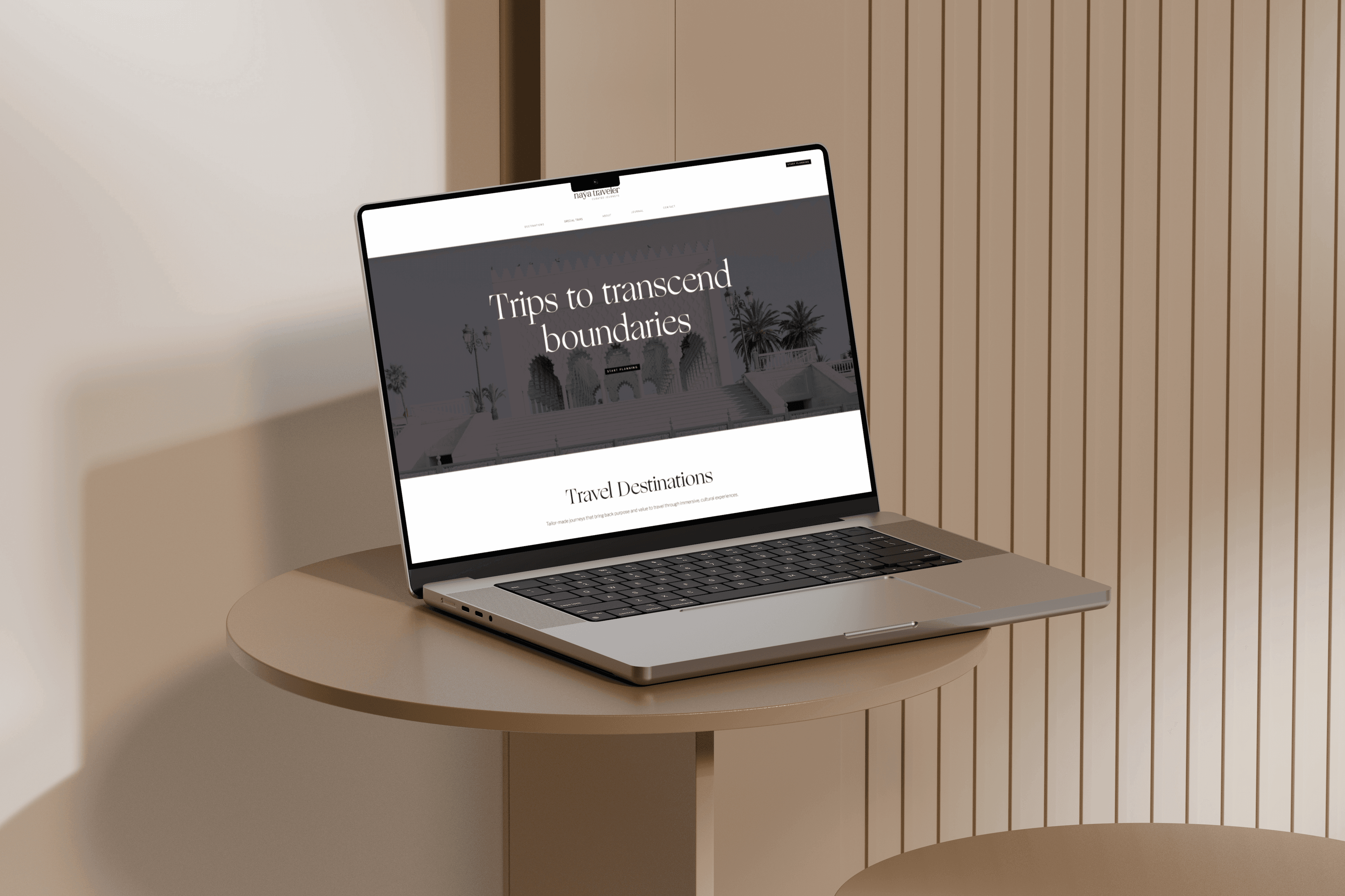
Goal
Increase the volume of qualified travel consultation requests by translating a private, high-touch luxury consultation into a narrative-driven editorial digital experience.
Challenge
High-net-worth travelers abandon destination and special trip pages because the standard template layout fails to convey the premium, bespoke nature of the service, forcing users to treat a highly curated cultural experience as a mass-market product.
Outcome
A narrative-driven editorial platform that lifted qualified premium inquiries by 38%, cut the bounce rate on specialized destination pages from 48% to 29%, and grew organic session duration on cultural articles to an average of 4 minutes 15 seconds.
Increased qualified premium travel inquiries by 38% through a narrative-driven editorial architecture that treats destinations as visual essays rather than standard holiday packages.
Project overview
Naya Traveler is an elite, female-owned luxury travel brand that curates hyper-personalized, culturally immersive journeys across remote global regions. The business model relies entirely on content-driven marketing to establish deep authority, gently shifting users from inspiration to high-value inquiries. The website serves as a high-end digital showroom and lead generation engine rather than a direct booking platform.
- A female-owned luxury brand curating hyper-personalized, culturally immersive journeys
- Destinations across South America, Central America, Asia & Middle East, Africa, Europe, and the Polar Regions
- A content-driven marketing model that shifts users from inspiration to high-value inquiries
- Positioned as a high-end digital showroom and lead generation engine, not a direct booking platform
- Looking like a budget aggregator was costing real bookings
- The legacy homepage asked for the sale before earning it
- Problem statement
- They did not want an itinerary, they wanted proof of curation
- Twelve conversations, not a survey
- Rejected: the drag-and-drop route builder
- Three ways in, one place to land
- Editorial pacing beat feature density, and the metrics agreed
- White text on bright landscapes was failing contrast
- A restrained system, where whitespace does the work
- Users rejected the floating button I was sure about
- The final product
- What it moved
- What I got wrong
Looking like a budget aggregator was costing real bookings
The legacy platform relied on standard, rigid structures that felt cold and transactional. That created a severe friction point for high-net-worth individuals who expect a premium, high-touch consultation experience from their very first digital interaction. One participant put the cost of it more plainly than any metric could.
- “If a travel website looks like a budget holiday aggregator, I automatically assume the ground staff will treat me like a lower-priority customer when I land.”
Where the competitors left a gap
Our team mapped top-tier travel publications alongside boutique agency platforms to locate the strategic opportunity.
- Black Tomato: excellent inspirational storytelling, but highly complex web navigation.
- Condé Nast Traveler: elite editorial typography and layout, yet transactional ad banners break immersion.
- Audley Travel: high operational trust signals, but feels mass-market and lacks artistic exclusivity.
- The gap: no competitor combined elite, unhurried print-magazine storytelling with a direct, friction-free gateway to a deeply personalized private consultation.
The legacy homepage asked for the sale before earning it
Before sketching layouts, I audited the live site to diagnose why we were losing high-value clients. Three problems, all the same mistake: the page wanted the conversion before it had given the reader any reason to trust it.
- Generic destination cards that fail to convey exclusivity.
- An immediate call-to-action button that fires before building any narrative or emotional connection.
- A lack of media features or social proof above the fold, creating a trust gap.
The team, and what the CMS allowed
As the UI/UX Designer I was responsible for executing the end-to-end design layout, translating user insights into high-fidelity interfaces, and managing the components. I worked under the strategic guidance of our Design Lead, collaborated closely with the Content Strategist to align typography hierarchies with the copy, and paired daily with two frontend developers to ensure our custom interface layouts could be reliably executed within technical boundaries.
Twelve weeks to launch before the peak winter booking season, on Squarespace. Any complex interactive layout I designed had to be achieved via clean frontend code overrides without breaking the core content management workflow the editorial team used.
Problem statement
High-net-worth travelers abandon destination and special trip pages because the standard template layout fails to convey the premium, bespoke nature of the service, forcing users to treat a highly curated cultural experience as a mass-market product.
They did not want an itinerary, they wanted proof of curation
We were not designing a standard travel website. We were designing the digital equivalent of an exclusive, private consultation room.
During testing on the legacy site we realized affluent travelers were not looking for granular schedules or pricing grids on the public platform. Showing an explicit itinerary actively made them feel the trip was rigid and pre-packaged. Under the guidance of our Design Lead, we shifted focus to sell the capability of unique curation, not a fixed, finished product.
The questions that framed it, and what we removed
Two guiding questions framed the exploration: how might we translate the feeling of a private, high-touch travel consultation into a digital editorial interface, and how might we leverage long-form photography and cultural essays to guide users toward the inquiry funnel without sounding aggressive.
- Removed: interactive calendar selectors and complex pricing calculators. Standard travel sites lean on these, and they caused visual noise and friction here.
- Prioritised instead: full-width visual essays, contextual regional summaries, and single-click callback triggers.
- The trade: feature density, sacrificed to preserve an unhurried, luxury aesthetic.
Twelve conversations, not a survey
Rather than generic online surveys yielding shallow quantitative metrics, we ran qualitative depth interviews and behavioral observation, to understand how affluent individuals actually discover, evaluate and choose a bespoke travel agency.
- Existing customers (4): recruited from the founder’s direct network, having booked luxury trips worth ₹15L and above.
- Inquiry leads (3): past abandoned CRM leads who dropped off after filling the old form.
- Travel enthusiasts (5): sourced through premium LinkedIn outreach, regular boutique hotel and private tour buyers.
And how we tested it
We tested the high-fidelity desktop and mobile layouts with a cohort of five premium users, tasking them with exploring a trip to the Polar Regions and requesting a custom itinerary.
Rejected: the drag-and-drop route builder
The first direction was a highly technical dashboard where users could drag and drop cities to build a tentative route. I built low-fidelity concepts for it, and internal testing proved it felt overwhelming and mechanical for this audience. We rejected the builder in favour of an elegant, narrative-led page hierarchy that mirrors the slow pacing of a luxury lifestyle magazine.
Three ways in, one place to land
Rather than restricting exploration to a single path, I engineered the interface around three real user behaviours, anchoring the Start Planning entry point across the navigation bar, the homepage hero and the journal posts.
- Funnel A, geographic, high baseline intent: home → nav or grid → Destinations hub → regional sub-page → content walkthrough → contextual Start Planning banner.
- Funnel B, thematic, inspirational discovery: home → Special Trips → thematic cluster → multi-country collage → persistent nav CTA → intake form.
- Funnel C, organic content loop, SEO and editorial: journal post → cultural story → inline service links → destination page → callback option or intake fields.
The full site map
To keep the design honest to the live ecosystem, I mapped the site and its exploration routes directly from production screens, around one centralised conversion goal: the dual-purpose lead page supporting both a deep-dive Start Planning form and an immediate Request a Callback trigger.
- Home: hero, destination slots, curated values, PR proof, newsletter.
- Destinations: regional hub spanning South America, Central America, Asia and the Middle East, Africa, Europe and the Polar Regions.
- Special Trips: interest-based portfolios including Adventure and Nature, Arts and Ateliers, Dish by Dish, Wellness Wanders.
- About: founder bio, philosophy, media press carousels.
- Journal: editorial blog hub and cultural essays.
- Contact: direct inquiries and general correspondence.
- Start Planning: central lead form and callback engine.
Editorial pacing beat feature density, and the metrics agreed
High-net-worth users are influenced by editorial prestige, trust metrics and visual authority, so the layout had to feel like an elite print publication rather than an online shop. I implemented an asymmetric grid with expansive whitespace, large editorial typography, and media validation placed directly beneath the brand messaging rows, carrying the Forbes, National Geographic and NYT logos.
On the regional pages the problem was different: users skimmed long blocks of destination copy and missed vital highlights, and dense paragraphs caused reading fatigue. On deep-dive variants like Mexico and Japan I introduced staggered content blocks with clean text summaries for climate, visa protocols and currency, without resorting to cheap, cartoonish icon grids.
- Page scroll depth increased 45%, with users spending significantly more time absorbing the narrative before acting.
- Average time on destination detail hubs increased 52%.
White text on bright landscapes was failing contrast
I took direct ownership of accessibility, keeping typography legible over rich imagery without compromising the aesthetic. The legacy approach layered pure white text over bright landscape images and failed WCAG AA. I engineered a mathematically smooth ambient linear gradient overlay behind the typography, clearing 4.5:1 without muddying the photograph underneath it.
A restrained system, where whitespace does the work
A compact design system held the platform together: a serif and sans-serif pairing and a tightly controlled palette, where generous whitespace does the heavy lifting in supporting the luxury layout.
The final product
Grand destination heroes flowing into clean regional overviews, with distinct subsections for climate, best times to visit and visa details set in typography rather than bulky icons, so the presentation stays sophisticated.
What it moved
Verified after the 2024 launch by cross-referencing frontend analytics against the company’s lead-capture data. Removing mass-market transactional clutter and focusing on high-end credibility did what it was supposed to.
- Qualified premium travel inquiries up 38%.
- Destination page bounce rate down from 48% to 29%.
- Average session on cultural articles of 4 minutes 15 seconds.
What I got wrong
We assumed high-net-worth users would want direct drop-down links to every sub-region in the main navigation. Early beta testing produced an overwhelming mega-menu that shattered the clean, minimalist aesthetic. We had prioritised quick link access over visual calm, and pivoted to the macro-continental buckets in the final layout.
At handoff I underestimated the optimisation needed to keep heavy full-width images loading under two seconds on mobile networks inside Squarespace. Working with the two developers taught me that technical performance is a foundational element of interface design: slow load times completely shatter the illusion of a seamless premium service.
What comes next
The next step is private, password-protected portal spaces where confirmed clients can view their customised interactive itineraries, keeping the high-touch design philosophy after the booking rather than only before it.
“We were not designing a standard travel website. We were designing the digital equivalent of an exclusive, private consultation room.”